



Whack-A-Mole: Chasing Constantly Changing TPS “Expiration” Dates
By Kayla E. Snider - Skoler Abbott P.C.
July 22, 2026
In a recent post, SCOTUS Clears Path for TPS Terminations – What Employers Need to Do Now, I discussed the impact of the Supreme Court’s recent decision regarding TPS status for Syria, Somalia, Yemen, Haiti, Myanmar (Burma), Ethiopia, and South Sudan. This post provides an update regarding the new “placeholder” dates that have been issued and attempts to provide some clarity to the TPS situation.
Update Employee Form I-9s with NEW Dates
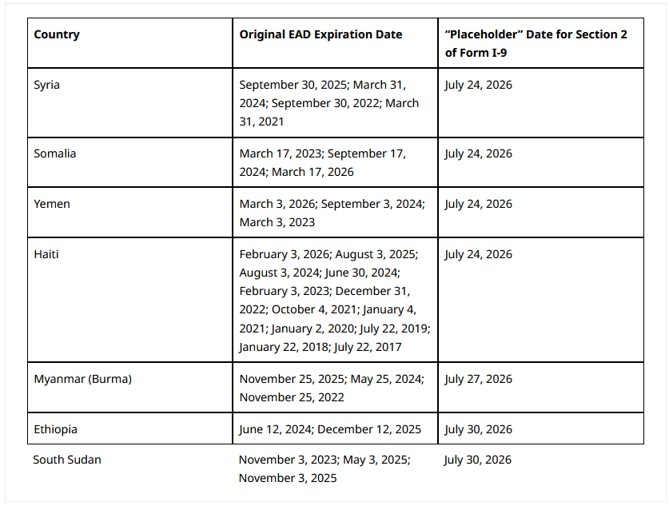
On July 17, 2026, United States Citizenship and Immigration Services (USCIS) once again updated several of the “placeholder” dates for individuals with TPS-related Employment Authorization Documents (EADs). Employers with affected employees should review their Form I-9s and update them accordingly. Specifically, EADs bearing the category codes A12 or C19, with the expiration dates listed below, have updated placeholder dates of:
What Do “Placeholder” Dates Mean?
You may have picked up on that I keep referring to these new ever-changing TPS dates as “placeholder” dates. I am calling them “placeholder” dates because (1) that is how they are referred to by USCIS and (2) that is precisely what they are. We have seen a lot of confusion regarding these dates and the impact that they have on employees’ ability to continue working. These “placeholder” dates are not deadlines for suspension or termination and should not be treated as the date affected employees will lose work authorization. Instead, these “placeholder” dates are just as the name suggests—dates that serve as a placeholder for the expiration date on Form I-9s but that will be constantly updated as remaining litigation and efforts to implement the termination of TPS status for Syria, Somalia, Yemen, Haiti, Myanmar (Burma), Ethiopia, and South Sudan proceed.
The Department of Homeland Security (DHS) is working to lift the remaining court injunctions that are blocking the termination of TPS status. If those injunctions are removed, employees with TPS-related EADs could lose their authorization to live and work in the United States, unless they qualify for another immigration status or source of work authorization. For employers, this ultimately will mean having to reverify a portion of their workforce and potentially suspending or terminating employment for those employees who cannot demonstrate work authorization unrelated to their TPS status once that status expires.
What Do Employers Need to Do NOW?
If you have not already, employers should conduct an audit to determine which of their employees are affected by the ongoing litigation related to the termination of TPS status for Syria, Somalia, Yemen, Haiti, Myanmar (Burma), Ethiopia, and South Sudan.
Employers should update Form I-9s for current employees with TPS-related EADs to reflect the new “placeholder” dates issued by USCIS. In addition to evaluating the impact the termination of TPS status might have on your workforce, you should also be developing a plan to reverify all of those employees. If TPS for Syria, Somalia, Yemen, Haiti, Myanmar (Burma), Ethiopia, and South Sudan is ultimately terminated, then employers will have to reverify all of those TPS employees on an accelerated timeline.
Lastly, employers should not discriminate in hiring practices, deny employment to new hires, or suspend/terminate employment for employees with TPS-related EADs from Syria, Somalia, Yemen, Haiti, Myanmar (Burma), Ethiopia, and South Sudan based on their TPS status. As discussed above, the current dates issued by USCIS are “placeholder” dates and it is entirely possible that all those dates are extended again so potential or current employees with TPS-related EADs remain eligible to work. While employers’ hands are tied now, all employers with affected employees should be coordinating with relevant internal personnel to plan for what you will do if these employees lose work authorization.
Reminder: Employers Should Verify All EADs
While the termination of TPS is certainly a hot topic right now, don’t let the game of whack-a-mole you’re playing distract you from ensuring that EADs unrelated to the ongoing TPS litigation are still valid and have not expired. There have been numerous changes to the length and availability of extensions to all EADs over the past year, so it is important that employers ensure they are in compliance across the board—not just for TPS-related EADs.
If you or your company have any questions about TPS and/or other visa categories, EADs, or proper procedures for updating Form I-9s consider contacting experienced employment-based immigration counsel.
Tweets 
We are having a problem with our Twitter Feed right now.